Surebeans vs Actual Budget
A lot of people who want to leave YNAB hear about Actual Budget as an alternative. Before you switch, consider if it's actually a good fit for you.
Actual Budget is fine software. It feels like YNAB, it's private, and it's free and open-source.
Except it's not free in some significant ways.
The self-hosting tax
To run Actual Budget, you have to run a server. That costs time and potentially money. For technical folks, setting it up is a weekend project. For a typical user, it's a non-starter.
Actual does have a desktop app, but it's crippled. The mobile app, sync between devices, and import from banks all require a server. Even their docs say "the standard way of using Actual is to set up a personal server and use a web browser for the application" 1.
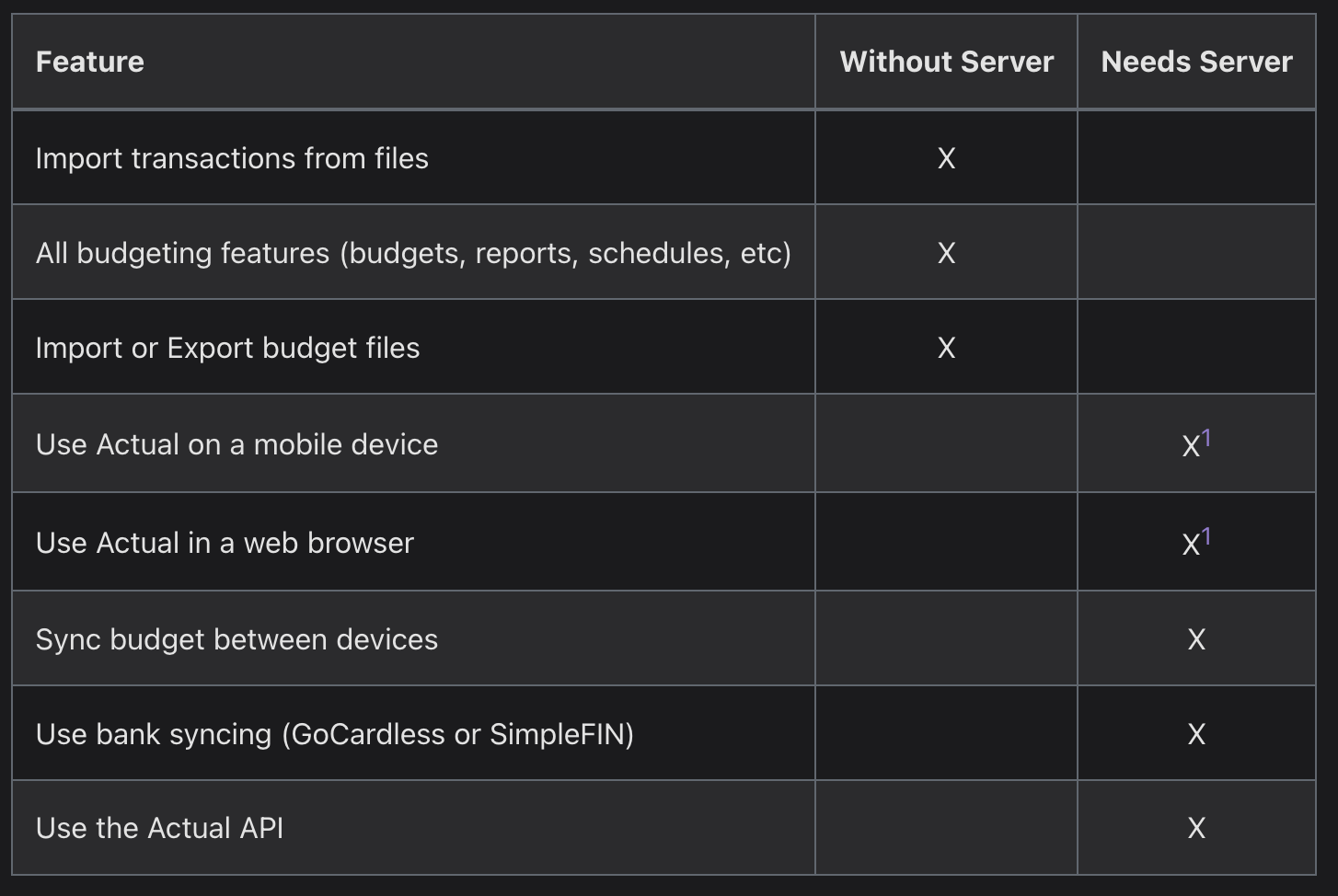 Pictured above: Actual Desktop's limitations
Even for techies, running a server is a headache. You have to procure hardware to run it on, such as a spare computer of your own or one you rent from a cloud provider. If you rent a VPS or container host and exceed the free tier, you'll pay a recurring fee. Once you have hardware, you deploy a Docker container to it. Show of hands, who has deployed a Docker container to the cloud before? Maybe 1 for every 10,000 people. Remember, you wanted to focus on your budget, not cloud hardware virtualization.
Then, to reach your Actual budget instance, you have to set up networking: VPN, port forwarding, reverse proxy, SSL certificates. Good luck with that. I'd rather lick pavement.
Once it's up, you have a long tail of maintenance: Your server is accessible from the internet, so you have to hope you don't get hacked. You have to stay on top of Actual's security updates, and those of its dependencies, and those of your operating system. You have to hope the hardware you're running on doesn't fail, or that the network doesn't go down.
If you succeed at all of this, you still have a problem: unless you managed to do all of this on hardware you own, your data sits on someone else's infrastructure. Speaking of data...
Your data is not free
The Actual Budget landing page claims "You own your data and can do whatever you want with it", but that's not the full story. You see, Actual stores your data in a SQLite database.
Do you know what a SQLite database is? It's a file, usually with an extension like .db or .sqlite3. That sounds simple, but it's a very complicated file. To read or change it, you need custom SQL code and an understanding of Actual's intricate database schema.
Let's imagine a very possible scenario: your Actual instance crashes, and you can't get it to start up again. You don't have backups. It's not running, so you can't export, and you can't use the API. All that you have is its SQLite file. Do you know how to recover your budget? If you're a software developer, maybe you do. Most people don't.
To put Actual's design choices in perspective, it originally started out as a closed-source, paid subscription product. The software subscription playbook includes locking users into using your app by making sure only it can read and write its data. Actual's technical choice to use SQLite optimized for capturing the user. Even as an open source app, the effects linger to this day.
Actual has CSV export, but you lose fidelity because CSV is a flat projection of a rich relational structure. Remember, you have to run Actual to create a backup or export. In contrast, when an app natively uses plain text files, recovery is possible with any text editor, and you're free to walk away at any moment with your data fully intact.
Imagine another YNAB alternative
What people loved about YNAB4, the discontinued desktop version of YNAB, was it was offline-first. It didn't need a server. The data format was plain text JSON files. It was private, it was simple, and it was an inexpensive one-time purchase.
YNAB4 was written in 2012. Imagine a modernized version. What could YNAB4 have looked like in 2026?
It would still be a one-time purchase, not a subscription. It would still be private, and not just when you configure your server right, because there is no server. Your budget would be a few text files on your computer. It would never leave unless you want it to. The app would sync between devices using established cloud services you already trust or using your own infrastructure.
Surebeans is that alternative
Surebeans is an envelope budgeting app that runs on Windows, macOS, Linux, and in your browser. Your data is stored locally in plain text files. It's human-readable and version-controlled. You can sync with cloud services that you already trust, or sync with your own infrastructure.
For your typical budgeter, that's a much better fit than Actual Budget.
Actual Budget claims to be free of cost, but Surebeans is much cheaper when you consider the value of your time.
Detailed Comparison:
| Actual Budget | Surebeans | |
|---|---|---|
| Source code | Open source | Proprietary |
| Privacy | Self-host for full privacy | Private by default, no server |
| Setup | Docker + server config | Download and run |
| Sync | Via your server | Dropbox, Git, SFTP, WebDAV, S3, GitHub, GitLab, Gitea/Forgejo |
| Bank import | GoCardless / SimpleFIN | Beanscrape (local browser) or SimpleFIN |
| Data format | SQLite | Plain text (hledger) |
| Mobile | Web app (via server) | Web app |
| Price | Free (self-host) or paid cloud | $79 one-time purchase |
| Maintenance | You maintain the server | Nothing to maintain |
If you like what Actual Budget stands for but don't want to babysit a server, try Surebeans. It provides better privacy with less overhead. If you like it, it's just one payment, not a subscription.
Coming from YNAB? Import your budget in a few clicks.
Coming from YNAB 4? Import a YNAB4 folder.
Coming from Actual? Import via CSV.